Search

Google
 
Showing posts with label Apple. Show all posts

2008/12/26

Paolini, Pullman with books coming to iPhones


NEW YORK – Christopher Paolini's "Brisingr," Philip Pullman's "His Dark Materials" trilogy and Peter Matthiessen's award-winning "Shadow Country" are among the dozen-plus books coming to the iPhone and to iPod Touch, publisher Random House Inc. announced Monday "We are pleased to be making this initial list of outstanding books by some of our top-selling authors available to a ground-breaking group of readers," Matt Shatz, Random House's vice president for digital books, said in a statement.

Random House recently announced it was adding thousands of books to its digital catalog and has said that e-sales more than tripled in 2008, although the electronic market remains a tiny part of the overall book market.

Several other publishers, including Simon & Schuster and HarperCollins, have been making e-books available on iPhones.

2008/12/25

Google, Apple, Microsoft Sued Over File Preview


A small Indiana company has sued tech heavyweights Microsoft, Apple, and Google, claiming that it holds the patent on a common file preview feature used by browsers and operating systems to show users small snapshots of the files before they are opened.

Cygnus Systems sued the three companies on Wednesday saying that they infringed on its patent with products such as Windows Vista, Internet Explorer 8 and Google Chrome, which allow users to view preview images of documents on the computer. Mac OS X, the iPhone and Safari also infringe, the company said in court filings. Apple uses this technology in its Finder and Cover Flow Mac OS X features, the filings state.

While Cygnus has sued three very high profile companies, there may not be the only vendors in Cygnus's sites. "They were a logical starting place for us," said Matt McAndrews, a partner with the Niro, Scavone, Haller & Niro, law firm, which is representing Cygnus. "We've identified many other potentially infringing products that we're investigating," he added.

Cygnus's owner and president Gregory Swartz developed the technology laid out in the patent while working on IT consulting projects, McAndrews said. The company is looking for "a reasonable royalty" as well as a court injunction preventing further infringement, he said.

The lawsuit was filed in federal court in Arizona, where Swartz resides, McAndrews said.

Google, Microsoft and Apple did not return messages seeking comment on the lawsuit.

Cygnus applied for its patent (# 7346850) in 2001. It covers a "System and method for iconic software environment management" and was granted by the U.S. Patent and Trademark Office in March of this year.

2008/03/20

Artificial muscle can power your Ipod


BOFFINS IN CALIFORNIA have developed a self-repairing artificial muscle that can generate enough electricity to charge an Ipod.

The top boffin in charge of the research, a scientist at the University of California, Los Angeles, named Qibing Pei, told the Discovery Channel that the artificial muscle was made up of flexible carbon nanotubes, which acted as electrodes. This is quite an improvement on previous artificial muscle models which tended to be metal based and have frequent failure rates with reuse. Pei reckons: "We've made an artificial muscle that, when you apply electricity to it, expands more than 200 percent”.

The way it works, is that as the artificial muscle material contracts after expanding, the carbon nanotubes rearrange themselves, causing a small electric current to generate, which can then be captured and stored in a battery.

It is also robust. If any part of the carbon nanotube packs up, the area around it seals itself off by becoming non-conductive, thereby stopping the defect from affecting other areas. The clever muscle is also eco friendly and energy efficient, conserving up to 70 per cent of energy pumped into it. Some boffins have suggested that it could even be used to capture wind or wave energy in the future to charge electrical devices.

The research could also lead to the creation of moving robots, better prosthetics, and battery charging energy sources. A self-repairing Ipod would be nice.

Apple bans music applications for IPhone


FRUIT THEMED toymaker Apple has decided that it will ban any third party applications for its iPhone that feature music-playing capabilities.

When Apple announced that it would allow third-party applications for the Jesus phone there was much back slapping among Apple fanboys. "See," they smugly said. "It proves that Steve Jobs, peace be upon him, is not a control freak after all."

That, however, is looking wildly optimistic. In June, Apple will open AppStore, an update to iTunes that will enable users to buy and download these third-party applications much like they already do music and video. It is a fairly cool bit of software with a licence that is wide open in favour of those who sell the software.

However it means that Apple gets to decide which applications it will sell. And that means that Apple can decide to ban anything that hurts iTunes.

For example, will it allow a rival, such as Amazon, to run a third-party application that will deliver music to the iPhone? The same applies to eMusic.

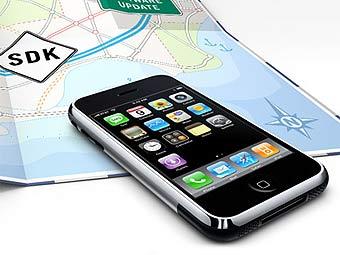
What hints that Apple might be such a bastard? Well the new SDK beta does not allow developers to have access to any iTunes functionality.

This makes it impossible for plug-ins to be created for iLike, Last.fm, Qloud or OnTour to create iPhone-compatible widgets that might expand basic iTunes functions.

2008/03/17

World's most expensive iPod goes on sale


The world's most expensive iPod has gone up for sale at a charity auction in London.

The popular music player was customised with hundreds of diamonds for a dazzling makeover.

Already a must-have item, the bejewelled version was the star of the auction, with an estimated value of £20,000.

The iDiamond shuffle is made of solid 18 karat white and pink gold and kitted out with 430 diamonds.

The one-off piece was created by jeweller, Thomas Heyerdahl, who says the process was painstaking and meticulous as there wouldn't ever be another one.

He said: "It's a special thing, making just one. If we had make this for commercial sale, it would be quite a different thing because then you have to take care of, much more things to make it work commercially."

A carbon-offset eco-holiday to a Himalayan retreat and a trip to a château in the Champagne region of France were also up for grabs at the auction.

2008/03/15

Apple Denying iPhone Developers In Droves

It appears that not anyone can sign up and become a registered developer for the iPhone. Apple is sending out rejection letters via e-mail. Twitterers are firing up their tweets in protest and anger.

According to The Unofficial Apple Weblog, people interested in developing for the iPhone are being rejected by the thousands.

Erica Sadun writes, "If you've applied for Apple's iPhone Developer program, check e-mail for your rejection letter. The twitterati are reporting widespread disappointment and anger as thousands of iPhone developer hopefuls have received a 'Thank you but no thank you' message in their in-box. The e-mails are arriving with the subject of 'iPhone Developer Program Enrollment Status'."

Have any of you received such notice? A number people have responded to Sadun's piece with comments. More than a few were among those rejected by Apple.

One commenter said, "Denied! That sucks!!! What is or was the criteria? Since the application did not ask you anything important like what are you planning on working on... Are people who are getting accepted top-level ADC members?"

So what does it take, Steve? Do you need to be an official company to develop applications for the iPhone? Do you need to already be an ADC member? Can individuals apply? What are the criteria which you are using to judge these developers? Are you too worried about hackers?

It might be fair to make those criteria public so people who won't qualify don't register in the first place. After all, over 100,000 people have downloaded the SDK.

As my colleague Mitch Wagner pointed out earlier this week, the SDK could indeed be the iPhone's Achilles' heel. The negative press generated by rejecting developers will only further tarnish Apple's image and anger developers even more than they already are.

Source: http://www.informationweek.com/blog/main/archives/2008/03/apple_denying_i.html

2008/03/13

iPhone software 2.0 allegedly unlocked


Apple's not-yet available iPhone 2.0 software has already been cracked -- before it even has shipped. At least that's what a renegade group of developers claimed Tuesday.

The iPhone Dev Team claims to have cracked the software, meaning yet more pressure on Apple Inc. in the cat and mouse game between software developers and the owners of a million unlocked iPhones and the company and its network partners.

The developers claim to have decrypted and have jailbroken the new iPhone software, and have published a series of screenshots of third-party applications running on the device.

The jailbreak currently only works with hacked activation, meaning it won't work with AT&T iPhones yet.

Apple executives have characterized the buoyant global market in unlocked iPhones as a positive thing, suggesting strong pent-up demand for the product, which is as yet available in just four markets: U.S., U.K., Germany and France.

2008/03/04

Just blink to control your Ipod


A RESEARCHER at Osaka University's Graduate School of Engineering Science has come up with a way to control devices by intentional blinking and winking.

Kazuhiro Taniguchi developed a system - which he calls "Kome Kami Switch" or "Temple Switch" - using a single chip computer and a pair infrared sensors. The whole thing is so small that it can fit into a pair of eyeglasses.

As an initial demonstration, he's adapted the Kome Kami Switch to control an Ipod. Closing both eyes for one second starts or stops the Ipod. Wink with the right eye to skip to the next tune or wink with the left eye to skip back.

As a hands-free control system, the switch can be a "third hand" for medical personnel, rock climbers, motorcycle riders, astronauts and disabled people.

"You don't have to worry about the system moving incorrectly as the system picks up signals when you close your eyes firmly. You can use this when you're eating or chatting with someone," said inventor Taniguchi. "Normally you blink in an energy-saving manner, very quickly and lightly, but you would close your eyes more firmly to operate a device."

He foresees the system being used to control a wide variety of systems, from televisions, air conditioners and room lighting to cellphones, wheelchairs and robots.

Taniguchi is also working on a similar system that works by clenching teeth.