Search

Google
 
Showing posts with label NASA. Show all posts

2008/12/25

Robot in frigid underwater dress rehearsal for future space mission

UIC scientists help monitor device as it explores Antarctic lake covered by 15 feet of ice

Робот ENDURANCE. Изображение с сайта arsgeek.com

A NASA robot tested last winter in an icy Wisconsin lake will complete a monthlong underwater mission in Antarctica on Thursday, having successfully explored dark, deep waters frozen off from the outside world tens of thousands of years ago.

Managed by a team from Chicago and Texas, the robot has hit its marks while patrolling Lake Bonney, a body of water locked under 15 feet of ice. The Antarctic lake is the nearest thing on Earth to outer space, and scientists hope lessons learned there will inform a future hunt for life in the ice-covered oceans of Jupiter's frozen moon Europa.

The robot overcame some technical surprises to gather information on the lake's internal structure—data many Antarctica experts once despaired of knowing—and spot a colony of microbes unlike any seen before.

Scientists named the robot ENDURANCE (for Environmentally Non-Disturbing Under-ice Robotic ANtarctiC Explorer) in a nod to the ship Sir Ernest Shackleton was forced to abandon on his failed Antarctic expedition a century ago.

The device patrols under the ice like a $5 million Roomba robotic vacuum cleaner while a pair of scientists with tracking antennas follow it across the ice above like overprotective parents.

Its only way out of the lake is a single, cubicle-sized hole in the ice that is guarded by researchers from the University of Illinois at Chicago. A fiber-optic cable is the sole lifeline that connects the robot to scientists waiting by the hole in wood-floored tents.

ENDURANCE was built by Stone Aerospace in Austin, Texas, from a design used for Mexican waters. When it first explored cold water in February at Lake Mendota in Madison, Wis., the sonar was iffy, thrusters balked, and it barely found its way back to the starting point.

Even after the robot arrived in Antarctica, some of its crew wondered if it would even work, said co-investigator John Priscu of Montana State University.

But in Antarctica, it motored flawlessly to all its destinations—determining its own routes underwater, evading obstructions and returning by dead reckoning to the team of relieved scientists.

The mission was not without challenges. Engineers at the site modified equipment not designed for cold water, programmed "danger zones" into the robot's memory when it found dangling old ropes and lost science instruments, and found ways to work around the surprising buoyancy added by gas bubbles in the lake.

As it hovers under the ice, the robot spools out a series of instruments every few minutes that measure water temperature and dissolved materials as well as taking pictures of the ice above and the dark lake floor below. Days after it began, the robot found what looked like an outcrop of lichen-covered rocks—microbial colonies that researchers said were unlike any others known to exist in the lake.

"There's some things in these images that I've never seen before," said investigator Peter Doran of UIC.

It also revealed details of what is essentially an ancient salt lake trapped under lighter, cold freshwater and a thick slab of ice, Priscu said in an e-mail from Antarctica.

"At this stage of the game, I would have to call ENDURANCE a success," he said.

2008/03/10

WMAP Reveals Neutrinos, End of Dark Ages, First Second of Universe


NASA released this week five years of data collected by the Wilkinson Microwave Anisotropy Probe (WMAP) that refines our understanding of the universe and its development. It is a treasure trove of information, including at least three major findings:

  • New evidence that a sea of cosmic neutrinos permeates the universe
  • Clear evidence the first stars took more than a half-billion years to create a cosmic fog
  • Tight new constraints on the burst of expansion in the universe's first trillionth of a second
"We are living in an extraordinary time," said Gary Hinshaw of NASA's Goddard Space Flight Center in Greenbelt, Md. "Ours is the first generation in human history to make such detailed and far-reaching measurements of our universe."

WMAP measures a remnant of the early universe - its oldest light. The conditions of the early times are imprinted on this light. It is the result of what happened earlier, and a backlight for the later development of the universe. This light lost energy as the universe expanded over 13.7 billion years, so WMAP now sees the light as microwaves. By making accurate measurements of microwave patterns, WMAP has answered many longstanding questions about the universe's age, composition and development.

The universe is awash in a sea of cosmic neutrinos. These almost weightless sub-atomic particles zip around at nearly the speed of light. Millions of cosmic neutrinos pass through you every second.

"A block of lead the size of our entire solar system wouldn’t even come close to stopping a cosmic neutrino,” said science team member Eiichiro Komatsu of the University of Texas at Austin.

WMAP has found evidence for this so-called "cosmic neutrino background" from the early universe. Neutrinos made up a much larger part of the early universe than they do today.

Microwave light seen by WMAP from when the universe was only 380,000 years old, shows that, at the time, neutrinos made up 10% of the universe, atoms 12%, dark matter 63%, photons 15%, and dark energy was negligible. In contrast, estimates from WMAP data show the current universe consists of 4.6% percent atoms, 23% dark matter, 72% dark energy and less than 1 percent neutrinos.

Cosmic neutrinos existed in such huge numbers they affected the universe’s early development. That, in turn, influenced the microwaves that WMAP observes. WMAP data suggest, with greater than 99.5% confidence, the existence of the cosmic neutrino background - the first time this evidence has been gleaned from the cosmic microwaves.

Much of what WMAP reveals about the universe is because of the patterns in its sky maps. The patterns arise from sound waves in the early universe. As with the sound from a plucked guitar string, there is a primary note and a series of harmonics, or overtones. The third overtone, now clearly captured by WMAP, helps to provide the evidence for the neutrinos.

The hot and dense young universe was a nuclear reactor that produced helium. Theories based on the amount of helium seen today predict a sea of neutrinos should have been present when helium was made. The new WMAP data agree with that prediction, along with precise measurements of neutrino properties made by Earth-bound particle colliders.

Another breakthrough derived from WMAP data is clear evidence the first stars took more than a half-billion years to create a cosmic fog. The data provide crucial new insights into the end of the "dark ages," when the first generation of stars began to shine. The glow from these stars created a thin fog of electrons in the surrounding gas that scatters microwaves, in much the same way fog scatters the beams from a car’s headlights.

"We now have evidence that the creation of this fog was a drawn-out process, starting when the universe was about 400 million years old and lasting for half a billion years," said WMAP team member Joanna Dunkley of the University of Oxford in the U.K. and Princeton University in Princeton, N.J. "These measurements are currently possible only with WMAP."

A third major finding arising from the new WMAP data places tight constraints on the astonishing burst of growth in the first trillionth of a second of the universe, called “inflation”, when ripples in the very fabric of space may have been created. Some versions of the inflation theory now are eliminated. Others have picked up new support.

"The new WMAP data rule out many mainstream ideas that seek to describe the growth burst in the early universe," said WMAP principal investigator, Charles Bennett, of The Johns Hopkins University in Baltimore, Md. "It is astonishing that bold predictions of events in the first moments of the universe now can be confronted with solid measurements."

The five-year WMAP data were released this week, and results were issued in a set of seven scientific papers submitted to the Astrophysical Journal.

Prior to the release of the new five-year data, WMAP already had made a pair of landmark finds. In 2003, the probe's determination that there is a large percentage of dark energy in the universe erased remaining doubts about dark energy's very existence. That same year, WMAP also pinpointed the 13.7 billion year age of the universe.

Additional WMAP science team institutions are: the Canadian Institute for Theoretical Astrophysics, Columbia University, University of British Columbia, ADNET Systems, University of Chicago, Brown University, and UCLA.

2008/03/05

Spring is Aurora Season


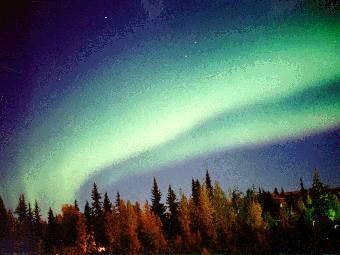
What are the signs of spring? They are as familiar as a blooming daffodil, a songbird at dawn, a surprising shaft of warmth from the afternoon sun. And, oh yes, don’t forget the aurora borealis. Spring is aurora season. For reasons not fully understood by scientists, the weeks around the vernal equinox are prone to Northern Lights. Canadians walking their dogs after dinner, Scandinavians popping out to the sauna, Alaskan Huskies on the Iditarod trail -- all they have to do is look up and behold, green curtains of light dancing across the night sky. Spring has arrived!

This is a bit of a puzzle. Auroras are caused by solar activity, but the sun doesn’t know what season it is on Earth. So how could one season yield more auroras than another?

“There’s a great deal we don’t understand about auroras,” says UCLA space physicist Vassilis Angelopoulos. For instance, “Auroras sometimes erupt with little warning and surprising intensity. We call these events ‘sub-storms,' and they are a big mystery.” What triggers the eruptions? Where is sub-storm energy stored? (It has to gather somewhere waiting to power the outburst.)

And, of course, why springtime?

To answer these questions and others, NASA has deployed a fleet of five spacecraft named THEMIS (short for “Time History of Events and Macroscale Interactions during Substorms”) specially instrumented to study auroras. Angelopoulos is the mission’s principal investigator.

Auroras are much more than just pretty lights in the sky. Underlying each display is a potent geomagnetic storm with possible side-effects ranging from satellite malfunctions in orbit to power outages on terra firma. Telecommunications, air traffic, power grids and GPS systems are all vulnerable. In a society that relies increasingly on space technology, understanding these storms is vital.

Launched in February 2007, THEMIS has already observed one geomagnetic storm with a total energy of five hundred thousand billion (5 x 10^14) Joules. “That's approximately equivalent to the energy of a magnitude 5.5 earthquake,” says Angelopoulos. “This storm moved twice as fast as anyone thought possible,” crossing an entire polar time zone in 60 seconds flat!

THEMIS may have found the storm’s power supply:

"The satellites have detected magnetic ‘ropes’ connecting Earth's upper atmosphere directly to the sun," says Dave Sibeck, project scientist for the mission at the Goddard Space Flight Center. "We believe that solar wind particles flow in along these ropes, providing energy for geomagnetic storms and auroras." Sibeck likens them to ropes because the magnetic fields in question are organized much like the twisted hemp of a mariner’s rope. Solar wind particles flow along the ropes in whirligig trajectories leading from the sun to Earth.

Which brings us back to spring.

It turns out that magnetic connections between the sun and Earth are favored in springtime. It’s a matter of geometry: As Earth goes around in its orbit, Earth’s magnetic poles wobble back and forth. (The poles don’t really wobble, but the combination of Earth’s 23-degree polar tilt plus orbital motion makes the poles seem wobble from the solar point of view.) Around the time of the equinox, Earth’s magnetic field is best oriented for “connecting-up” with the sun, opening the door for solar wind energy to flow in and spark Northern Lights.

But wait, there are two equinoxes, spring and fall, with similar magnetic geometry. Indeed, autumn is aurora season, too. Geomagnetic disturbances are almost twice as likely in spring-fall versus winter-summer, according to historical records.

THEMIS is just getting started. The five spacecraft are on a two-year mission to explore Earth’s magnetic field and they are only now settling into their optimum science orbits. “With five satellites, we can map the complex ebb and flow of energy during geomagnetic storms better than any single satellite ever could,” points out Angelopolous. “There’s no telling what we might learn.”

One thing is certain, though. 'Tis the season for auroras -- and lots of data for THEMIS. Says Sibeck, “We welcome the spring!”