Search

Google
 
Showing posts with label Asus. Show all posts

2008/12/25

Psion pushing takedowns over "netbook" name


Sites using the term "netbook" to refer to the recent wave of mini notebooks are starting to receive cease and desist letters over its alleged infringement of a trademark for a Psion device with a similar name, say site owners reporting their problems to jkOnTheRun. The largely defunct PDA maker has claimed that various enthusiast pages are inadvertently using the name of its discontinued netBook and netBook Pro devices and is asking the sites to phase out use of the term by the end of March. Psion doesn't say what the consequences will be but warns that continued use will "damage" its trademarks. The accusations are controversial both through their attempt to link a generic term to a no longer produced device but also through their implications for Intel, which is largely credited with inventing the modern use of "netbook" and promoting its use. No action is yet known to have been taken against Intel, nor have any immediate links been made between Psion's Linux-based organizer and the newer, more abstract concept.

The current definition of the word refers to a very small notebook built primarily for accessing the Internet and which doesn't need large amounts of processing power or storage as a result. Psion's device shares similarities in its blend between PDA and notebook functions but is focused more on offline content and runs a relatively feature-limited operating system versus the full Linux or Windows XP operating systems on today's systems.

2008/03/11

Notebooks based on Intel's Atom to cost between $250 and $300

More than 25 low-cost notebooks based on Intel Corp.'s upcoming Atom processor are in the works, including models from multinational PC vendors, according to the chip maker's top executive in Asia.

These Atom-based notebooks will be available in the middle of this year for about $250 to $300, said Navin Shenoy, general manager of Intel's Asia-Pacific operations, in an interview. "We'll see some slightly richer configurations that get up to $350," he said.

The Atom processor, formerly called Diamondville, is a small, low-power chip designed for inexpensive notebooks, a class of device that Intel and others refer to as netbooks. These machines are intended for first-time computer buyers in emerging markets, as well as users in mature markets who are willing to trade performance for a low-cost notebook that complements their existing computers -- a market that until now has been largely dominated by Asustek Computer Inc.'s Eee PC.

Atom will offer lower performance than Intel's Core 2 Duo processors for mainstream notebooks, but its performance will be good enough for browsing the Internet and sending e-mails, Shenoy said.

Intel Chief Technology Officer Justin Rattner was more specific about the processor's capabilities last month, telling reporters that a related chip, called Silverthorne, offers performance similar to Banias, the first version of Intel's Pentium M processor released in 2003. Silverthorne is designed for small, handheld computers that Intel calls Mobile Internet Devices, and will be available as part of the Centrino Atom chip package set for release during the second quarter.

The introduction of the Atom and the rush of vendors to build the chip into low-cost notebooks could mark the emergence of a new type of device, expanding on the early success of Asustek's Eee PC. But not everyone is convinced that there is much demand for low-cost notebooks, either as a secondary computing device or a substitute for a more capable, and more expensive, notebook PC.

Bryan Ma, director of personal systems research at IDC Asia-Pacific, is a self-described skeptic and doubts that low-cost notebooks will have more than a limited impact on the market for portable computing devices as long as performance and features are traded for lower prices. "I was never convinced that price was the best way to sell these products," he said.

But the marketing clout of Intel and top-tier PC vendors could alter this equation by creating additional demand among customers in both emerging markets and developing countries. "Intel pushing this gives it more legs," Ma said.

"There's going to be some experimentation," Shenoy said.

Most Atom-based notebooks will have screens ranging in size from 7 in. up to 10 in., Shenoy said, adding that some models will be equipped with screens that can swivel and lay flat against the keyboard, turning the device into a tablet computer. Devices will ship with either hard disks or solid-state drives that use flash memory and offer battery life ranging from three to five hours, he said.

"Some will be really sleek and thin; some will be a bit more ruggedized," Shenoy said, adding that Wi-Fi will likely be a common feature.

On the software side, Atom-based notebooks will ship with either Windows XP or some version of Linux. "I don't think you'll see a lot of Vista in this space for cost reasons," Shenoy said.

The availability of Windows XP on low-cost notebooks set to arrive during the middle of the year is noteworthy because Microsoft Corp. has stated that Windows XP licenses will not be sold after June 30. Microsoft officials in Singapore reaffirmed the June 30 deadline in a statement released through the company's public relations agency. But that doesn't necessarily mean that Windows XP will completely disappear after June 30.

"There are probably going to be certain exceptions here and there," IDC's Ma said.

New Eee PC will use Intel's new Atom


Asus' head honcho has spilt more beans on details of the version two Eee PC model. It will use Intel's recently-branded Atom processor designed for sub-notebook machines just like the Eee and its growing band of rivals.

In an interview with Laptopmag.com, Jerry Shen said later versions of the Eee PC may even come with a built-in hard drive as opposed to solid state. New versions of the machine were announced at last week's CeBIT show for launch in the summer.

A Windows XP version will be available - the 8GB Eee PC 900, while storage now tops out at 12GB for the high-end model with Linux on board. That'll replace the current Eee PC 701 model.

The new machines will feature the 'Diamondville' derivative of the 45nm Atom processor. The chip is a 1.6GHz low voltage, single-core variant with a 512KB cache. A dual-core version seems likely to follow.

New colours also planned

What's more, the Eee will ship in other colours. Shen said there would be "a very new colour design" introduced in the early summer.

The new 900 will cost €399 and will boast an 8.9-inch screen. Asus said the model was on the way during its press conference at CES in January, when it also announced it was working with Intel to provide WiMAX support on the machine.

This won't be in available until later in the summer it seems, but will instead be in the third-generation machine late this year - also depending on partnerships with WiMAX or cellular providers.

Asus is quoting quite staggering sales figures for the machine. Some 350,000 have been sold since launch with a projected 3 to 5 million units to be sold this year. The diminutive lappy is certainly creating a lot of interest.

Any hard drive-based Eee won't appear until far later in the year, said Shen.

Source: http://www.tech.co.uk/computing/mobile-computing/notebooks-and-tablet-pcs/news/new-eee-pc-will-use-intels-new-atom?articleid=326404251

2008/03/05

Asus shows new Eee PC with larger screen


March 4, 2008 (IDG News Service) The anticipated new version of Asustek Computer Inc.'s low-cost Eee PC with a larger screen has made its debut at the CeBIT trade show.

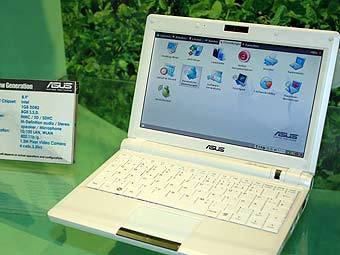
The new Eee PC 900 model sports an 8.9-in. screen -- a couple of inches larger than the 7-in. display on the original computer -- and more storage capacity. It has a 12GB, solid-state disk (SSD) drive, which is 50% greater than the largest drive available on current machines.

SSDs are replacements for hard disk drives that store data on flash memory. They offer better performance and lower-power consumption but are more expensive.

Other features of the new computer include 1GB of memory, Ethernet connection, 802.11b/g wireless LAN, 1.3-megapixel camera and a card reader for MMC, SD and SDHC memory cards. About three and a half hours of battery life is expected from the computer's 4-cell battery, said Asus.

The machine is expected to go on sale in the middle of this year and will cost €399 ($606 U.S.).

Asus has high hopes for the expanded Eee PC range and hopes to sell between 3 million and 5 million of the machines this year. Since its launch last year, sales have totaled about 350,000 units.

The Eee PC first debuted at the Computex trade show in Taipei in June 2007. The basic model is currently available in four configurations with the main difference being the size of the SSD storage. The cheapest model packs just 2GB of space while the most expensive of the four has an 8GB SSD.